Photograph courtesy of World Central Kitchen.
By BGR Staff
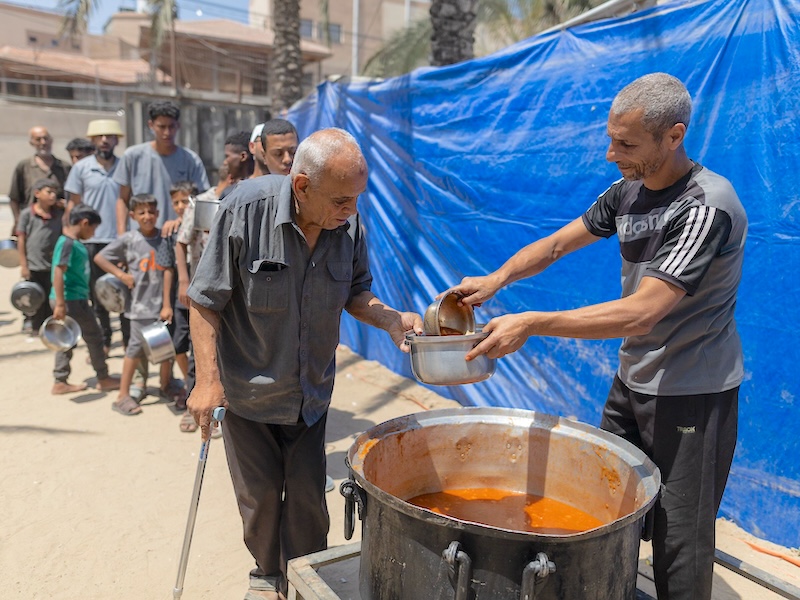
In any conflict or disaster, senior citizens are among the most vulnerable to food insecurity. In Gaza, where displacement has left many without consistent access to food, the journey to find a meal can be long and exhausting. World Central Kitchen’s team met 70-year-old Izzat Abdel Aal Al-Shafie, displaced from his home in North Gaza and making the trek himself to access food. Izzat told us: ‘When the meals reach us, we feel that someone still remembers us and cares about us.’
For Izzat and so many others, a hot meal is more than sustenance, it’s a reminder that they have not been forgotten. WCK’s teams meet people where they are—in camps, shelters, hospitals, the roadside—because to us dignity should not depend on how far someone can travel to receive food.
—World Central Kitchen
The international hunger-relief nonprofit World Central Kitchen (WCK) was founded by Chef José Andrés in the aftermath of the 2010 earthquake in Haiti to support food security throughout Central America and the Caribbean. Over the last decade, WCK has greatly expanded its crisis-response work, providing meals to people living through crises—natural disasters like hurricanes and wildfires, conflict as in Ukraine and Lebanon, and urgent circumstances like those of frontline workers during the pandemic or refugees recently arrived to the U.S. following difficult travel.
Since 2024, BGR crisis grants have provided funding for WCK’s hunger-relief work in Gaza, where widespread infrastructure destruction, population displacement, and the blockade of humanitarian aid by the Israeli military has caused hunger so severe that famine was declared in August 2025. (In April 2024, a team of seven WCK workers were killed by an IDF airstrike during a humanitarian-aid food delivery.)
A 2025 BGR crisis grant directly supported WCK’s bread production efforts. Working from three mobile bakeries in areas with high numbers of displaced families as well as in partnership with local bakeries, the project provided more than 200,000 loaves of bread to Palestinian families in need in a time of extreme food insecurity.
The bread production project is only one aspect of a multifaceted relief project in Gaza. WCK continues to provide 300,000 hot meals each day from several large-capacity field kitchens serving displacement camps and other areas of high need, as well as a network of community kitchens and restaurant partners. WCK has also installed a number of reverse osmosis desalination units and fresh water distribution points to provide safe drinking water in areas where infrastructure damage has limited access to clean water.
Other initiatives supporting Palestinians living in areas of great need included fresh fruit and vegetable distribution for children and hospital patients; infant formula and other essential nutritional support for babies and young children, pregnant women, and new mothers; hot school meals providing necessary nutrition for 12,000 students; and the distribution of flour and stoves for bread-baking in devastated areas of North Gaza and Khan Younis.
As of July 2026, the IPC (Integrated Food Security Phase Classification, the international authority on food security analysis and measurement) reports that, while Gaza is no longer experiencing famine conditions, more than 1.2 million people still face crisis levels of hunger or worse. It also projects that the number of people impacted by severe hunger is likely to increase over the coming months.
This article is based on reporting from WCK. Learn more about WCK’s work in Gaza on their website, wck.org.