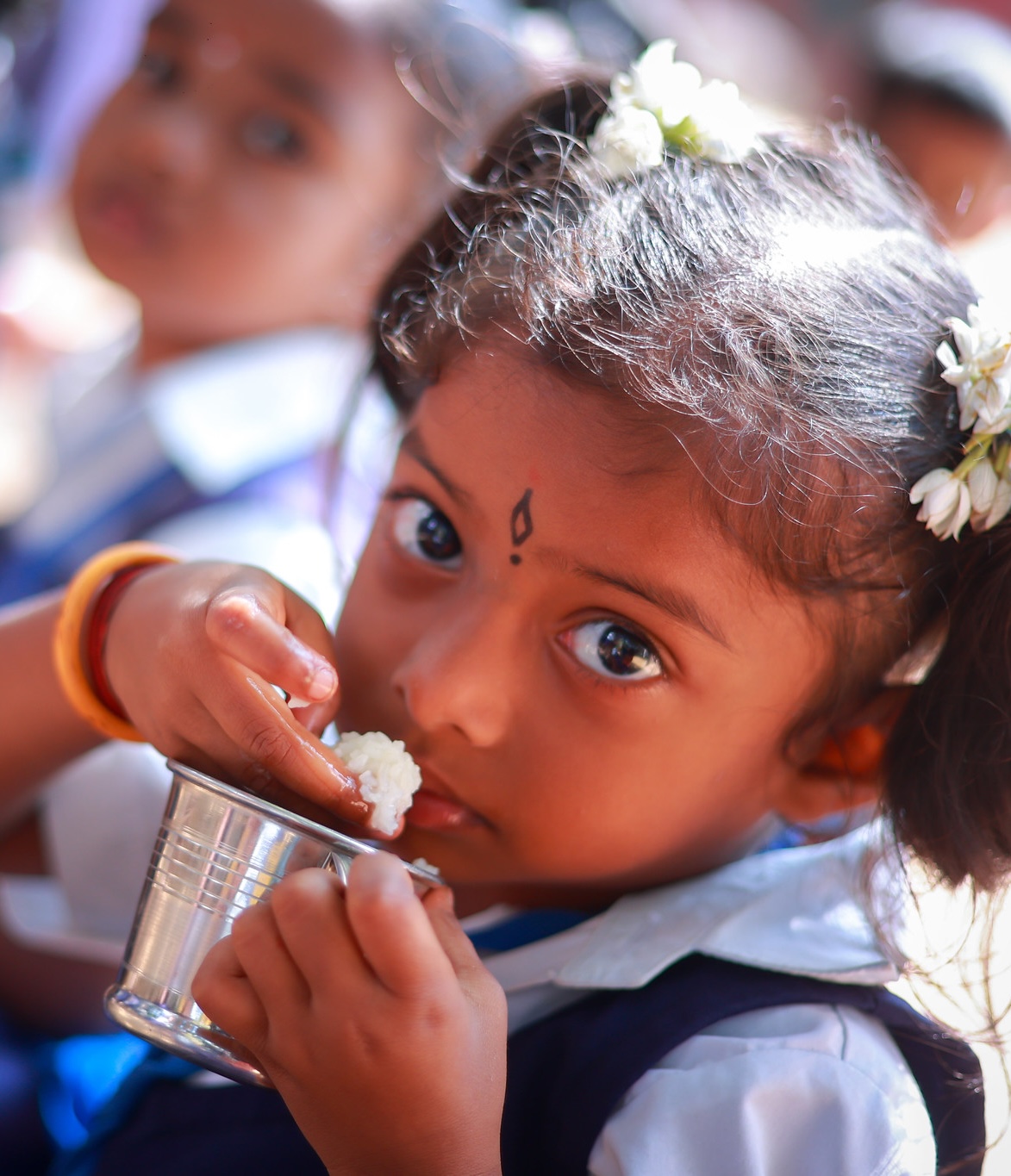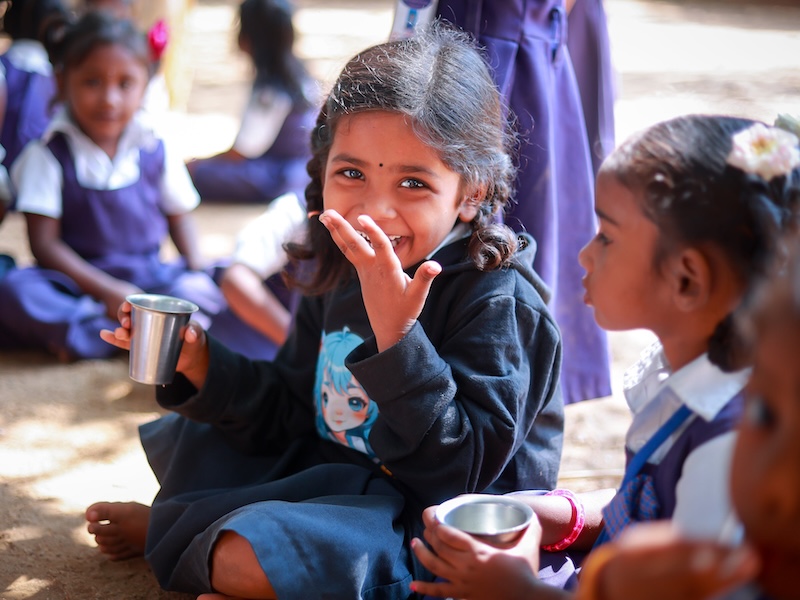
The Garden of Peace School in Tamil Nadu, India, where BGR has supported a school lunch program since 2017.
By Ven. Bhikkhu Bodhi
The heart of the Buddha’s teaching, the framework of the four noble truths, begins with dukkha, the truth of suffering. Dukkha is the thorn embedded in our flesh, the swarm of mosquitoes biting our arms and legs, the shadow that trails us even when we bask in the sunlight. Suffering, however, is not the final word the Buddha leaves to us. It’s only the starting point, highlighting the hard truth that our “house is on fire,” that our lives are ever entwined with pain and dismay as we wander through the wilderness of repeated birth and death. The Buddha begins with the truth of suffering because that is the lesson we have to learn. But his intention is to guide us toward the end of suffering, and it is this, the bliss of liberation, that he offers as the final goal.
The goal is to be reached by following a precisely calibrated path—a path with many facets—and one quality that permeates the entire path from start to finish is joy. Joy tends to be neglected in present-day accounts of Buddhism, which often depict the Dhamma as an austere discipline of grim resignation rather than as a road to ebullient freedom. In actuality, however, to walk the path is inherently joyful, a process of moving into an open expanse untainted by the ancient baggage of greed, hate, and delusion. But joy not only lends its flavor to the path as an incidental side-effect. It is also one of the factors central to the practice, contributing to its sequential unfolding.
We can see the pivotal role that joy plays in the ascent toward liberation in a series of terms laid out in the Upanisa Sutta, a short discourse in the Samyutta Nikāya (SN 12.23). The discourse features the familiar formula of dependent origination, which usually ends with birth as the condition for old age and death. But in this sutta, birth is said to be the condition—not for old age and death—but for suffering (dukkha). Suffering then becomes the condition for faith (saddhā), and faith initiates a new positive series that ascends through ever higher stages that culminate in the mind’s release from bondage.
The Pali word saddhā, translated here as “faith,” does not mean uncritical belief in unverifiable doctrines but solemn trust in the guides we turn to as our refuge: trust in the Buddha as our teacher, trust in the Dhamma as the liberating truth, trust in the course of practice as the way out of our existential predicament. According to the sutta, faith gives rise to joy. Joy brings delight, and from delight emerge in turn tranquility, bliss, concentration, and wisdom. Finally, from wisdom comes dispassion, and from dispassion liberation.
Faith is thus the portal of the Buddhist path, but once faith has arisen, it has to be cultivated—strengthened, consolidated, and propelled toward joy. It is by engaging in wholesome practices, undertaken through faith, that we intensify the initial joy that accompanies the act of faith and drive it higher. The ancient sources summarize these wholesome practices as giving, observance of precepts, and meditation—dāna, sīla, and bhāvanā. It’s important to note that success in meditation rests on the practice of giving and observance of precepts, which jointly serve as its foundation. But giving and the observance of precepts—experienced subjectively as generosity and moral virtue—can become themes of recollection and thereby subjects of meditation in their own right. As subjects of meditation, they can give rise to joy and unlock the process that culminates in liberation.
The theme for meditation that pertains most directly to the work of Buddhist Global Relief—and to our roles as BGR team members and supporters—is the recollection of generosity (cāgānussati). Since the mission of BGR is to tackle the problems of chronic hunger and malnutrition, both often rooted in poverty, war, and social inequalities, confronting the suffering intrinsic to these crises can dampen our spirits and paralyze our wills. To counter this, to sustain us in the valiant work of uplifting others, we need more than a stubborn commitment to altruistic ideals. We need to be buoyed up by joy, nourished and sustained by joy.
One means of generating such joy is the recollection of generosity. Generosity becomes a basis for joy because it breaks down the barriers we instinctively erect between ourselves and others. Ordinarily, through the influence of greed and delusion, our minds create a wall of separation between ourselves and others. We look at other people through the window of this prison—the fortress of the ego—and see them as competitors in the struggle to get by. Life then becomes a zero-sum game in which either we win or others win. This discord, this battle to prevail, is inevitably accompanied by anxiety and stress, by the dark trail of dukkha.
The practice of generosity breaks down this wall of separation and opens up new vistas from which we can recognize our intimate connections with others. Generosity thereby inspires kindness and compassion; it enables us to identify with those in need and moves our hearts to act for their benefit. Through generosity, we transcend the narrow, constricting outlook of the egocentric mind, scale the heights, and acquire that panoramic view that inspires us to act for the happiness and well-being of others.
But generosity has to be developed in stages. Initially, when we first feel the inclination to give, the innate disposition to self-interest may step in and try to convince us that acting upon our generous impulses will be harmful to ourselves. While we must refuse to listen to these suggestions, we should also recognize that they contain a kernel of truth. We can’t start with grand acts of utter self-sacrifice, by completely abandoning all for the sake of others. In the practice of generosity, the key to success is to begin with small gifts that don’t strain our capacity to give. When we give in moderation, and then reflect back on our act of giving, we will feel a surge of joy, rooted in the conviction that we have taken a decisive step—even a small step—toward self-transcendence. This opens up space for greater generosity, creating a stronger disposition to expand our capacity to give ever more abundantly.
Each act of giving encourages further giving until we can give freely, with open hands, full of happiness and joy. It is said that a bodhisattva delights in giving even his life, body, blood, and organs, doing so over countless eons. This capacity is not acquired overnight. It begins modestly, with small acts of giving repeatedly practiced until they gain an unstoppable force. It is like a snowball that rolls down a mountain, gathering ever more snow and thereby starting an avalanche.
Generosity is joyful in itself, but when practiced from faith, in the conviction that it is a stepping stone toward liberation, it can become a theme for recollection. We reflect back on our acts of giving, not to reinforce our self-esteem, not to win praise and honor from our peers, but to generate wholesome joy. We rejoice in the realization that we are dismantling the barrier of self-concern that separates us from others; we rejoice in our capacity to identify with the pain of others and to share our resources. Such reflection causes a wave of joy to swell up from within and paves the way to higher stages of happiness. This in turn can lead to concentration and insight, and eventually to the wisdom that uproots all clinging.
We can generate wholesome joy, not only by rejoicing in our own generosity, but also by rejoicing in the goodness of others, especially in their generosity. This is an aspect of muditā, altruistic joy, the antidote to envy and resentment. Too often, when we witness others doing exceptionally good deeds, we may see this as a blow to our self-esteem, apprehensive that they are better than we are. The cultivation of muditā overcomes this toxic tendency. It removes envy and resentment and allows us to share in the goodness of others by rejoicing in their good deeds.
The practice of muditā pertains quite intimately to the work of Buddhist Global Relief. When we learn of the compassion and generosity of our donors, when we witness the selfless service of our staff and team members, we can pause for a moment and rejoice in their goodness. We thereby turn this reflection into a meditative exercise that expands by stages. We begin by generating joy in the generosity and compassion of our friends and colleagues. From there, we extend the joy more widely, from those we know to others we don’t know but hear about, and then to those we don’t even hear about but can only imagine. Finally, at the widest level, we can rejoice in the goodness and generosity of all people of good will throughout the world, even in distant lands.
Rejoicing in the goodness of others has a resonance effect: it strengthens joy in our own hearts, grounds our life on a foundation of joy, and helps us spread joy to all who enter our sphere of influence.
Ven. Bhikkhu Bodhi is the founder and chair of Buddhist Global Relief.