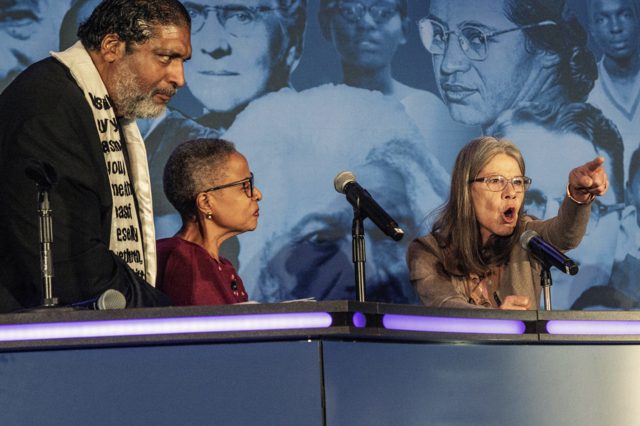
Pamela Garrison, co-leader of the West Virginia Poor People’s Campaign, speaks to conference attendees about “the hard work of being poor” as Bishop William J. Barber II and Bishop Yvette Flunder look on. Photograph by Timothy Cahill, courtesy of Yale Divinity School.
By Ven. Bhikkhu Bodhi
How should Buddhism engage with the critical issues currently facing this country and our world? Ven. Bhikkhu Bodhi proposes the need for a “Buddhist public theology,” an ethical lens through which Buddhist teachers and thinkers can evaluate public issues in light of the Buddha’s teachings.
This past April, I had the privilege of attending the 2026 Conference on Public Theology and Public Policy at the Yale Divinity School in New Haven, Connecticut. I went as a participant, not as a speaker, and was joined by Ven. Hong Hui, one of the bhikkhunis (Buddhist nuns) at Chuang Yen Monastery, where I live. The three-day conference was convened by Bishop William J. Barber II, the founding director of Yale’s Center for Public Theology and Public Policy and a professor at Yale Divinity School. Bishop Barber is one of the outstanding moral leaders of our time—president of Repairers of the Breach and co-chair of the Poor People’s Campaign, a “moral fusion” movement that tackles the interlocking problems of poverty, racism, the war economy, climate devastation, and religious nationalism.
The conference offered a rich assortment of panel discussions on the critical issues currently facing our nation as we approach November’s midterm elections. The panels focused especially on the impact present policies are having on the poor, undocumented immigrants, and other vulnerable communities. While the conference organizers were rooted in the Christian tradition, only a few panelists spoke from a specifically theological angle. Most adopted a broad perspective, dealing with their assigned themes from a critical moral and spiritual point of view. The speakers included Ruth Ben-Ghiat, a specialist on authoritarian “strongmen”; Nancy MacLean, a historian whose work focuses on the rise of the anti-democratic oligarchy; Pam Garrison, a coal miner’s daughter who co-leads the West Virginia Poor People’s Campaign; Ezra Levin, co-founder of the grassroots organization Indivisible; and Sloan Meek, a disability rights activist—blind, with cerebral palsy—who gave a stirring speech on the need to protect Medicaid. The conference also featured a jazz-infused gospel band and women’s choir that rocked the hall with inspiring musical performances.
The panelists highlighted the rising threats to our democracy posed by a radical clique keen to impose on our country an authoritarian regime unchecked by institutional restraints. But they also reminded us of our own capacity to instigate a peaceful revolution defending democratic values. Bishop Barber emphasized that our task is not merely resistance but to advance a positive program of “loving forward together.” Motivated by love—love for all people, including those we oppose—we are to move forward, taking bold steps toward a more just, inclusive society. And we are to do this together, acting in solidarity with one another to create a social and political order inspired by unconditional love.
Toward a public “dharmology”
As I left the conference I found myself grappling with troubling questions about the role that Buddhism should be playing in this country and in our present-day world. I was pleasantly surprised to find that Ven. Hong Hui, a Taiwanese bhikkhuni from a traditional Chinese Buddhist background, echoed my thoughts. As the conference ended, she said to me: “Why don’t we Buddhists have conferences like this? We are so locked into our narrow routines of rituals, textual studies, and silent retreats that we’re failing to respond to the critical issues people face in their everyday lives.”
Of course, Buddhism has generated a rich heritage of social activism known today as “socially engaged Buddhism.” But socially engaged Buddhism has mostly manifested as specific activist projects motivated by Buddhist ideals: Buddhists against racism; ecological Dharma; Buddhists in peace work; Buddhist advocacy for immigrant rights or women’s rights or gay and trans rights; in Asia, critiques of the caste system and opposition to military rule. To provide a stronger backbone to engaged Buddhism, what is needed is a deliberate effort to create a “Buddhist public theology,” a coherent, cogent, and doctrinally sound Buddhist ethical framework that can be used to examine the vital issues of our time. Although Buddhism lacks a theos—a personal God—as its ethical center, the Dharma fulfills a corresponding function, serving as an objective, universal, unshakable source of ethical injunctions and values that impinges on human life and makes demands on our conduct. Such a Buddhist theology (or “dharmology”) would provide a standard for evaluating, from a dharmic point of view, the laws, policies, and governmental programs that determine the quality of our collective lives. The framework would help assess such issues as environmental policies, international relations, immigration policies, economic policies, and a host of other issues of paramount public concern. It would give us a sharp lens—a dharmic lens—in terms of which we could view their moral and spiritual implications.
Here in the West, Buddhism has tended to take the route of withdrawal rather than active community engagement. Many people adopt Buddhist practice as a path of inner cultivation through meditation and philosophical reflection that shuns any focus on the wider social ramifications of the Dharma. Others approach Buddhism as a regimen of mental hygiene offering relief from stress, anxiety, and traumatic pain. Too often, we are told to see our suffering as a symptom of personal failure springing from our refusal to accept things as they are—a slanted perspective that fails to recognize that so much of the pain people face springs from inequitable social systems rather than from their personal deficiencies.
A critical Buddhist public theology would correct this distorted picture by laying bare the enormous suffering created by oppressive institutions, parasitical policies, and unjust laws. We shouldn’t just “accept things as they are.” We must advocate for fundamental changes in policy that can bring relief to people suffering from the impact of structural violence. To act to alleviate suffering, to promote the welfare of sentient beings, entails an obligation to confront and transform the wider social systems responsible for so much suffering.
This means we must reject the common belief that Buddhism should eschew political issues. Politics has tremendous ethical implications that call for a conscientious response. Public policies determine whether our budget will prioritize bombs or schools; whether people will get health care or fend for themselves; whether they will have homes or live on the streets; whether wealth will be fairly distributed or concentrated in the hands of a privileged few; whether we’ll switch to a clean-energy economy or continue extracting fossil fuels. Buddhist theologians would serve as voices of conscience, evaluating policies and laws through the ethical lens offered by the Buddha’s teachings. The Dharma might also be used as a matrix for formulating, in outline at least, the kinds of policies that could shape a social order that accords with Buddhist ethical and spiritual values.
The ruler who governs by the Dharma
We can find resources for such a Buddhist public theology in suttas describing the legendary rājā cakkavatti, the “wheel-turning monarch,” the universal ruler who institutes a reign of global prosperity and peace (Digha Nikāya no. 26). The wheel-turning monarch is the secular counterpart of the Buddha, exercising in the domain of governance the same kind of moral authority that the Buddha exercises in the domain of spiritual realization. Both the wheel-turning monarch and the Buddha are said to wield their authority in dependence on the Dharma, which each promotes in their own distinctive ways (Anguttara Nikāya 5:131). The Dharma is at once both the objective principle of righteousness that sustains the world and the path of cultivation that leads to transcendence of the world. The wheel-turning monarch relies on the Dharma in its world-sustaining capacity to establish a regime of justice, shared prosperity, and universal peace. The Buddha relies on the Dharma in its world-transcending capacity to lead beings out from the bondage of repeated birth and death.
While they rely on distinct aspects of the Dharma, the Dharma that they uphold is essentially the same, merely applied to different spheres. In its mundane application, this Dharma entails the policies and programs that flow from the imperatives of justice and compassion. The task of the wheel-turning monarch, according to the texts, is to provide “righteous protection for all in his realm,” ensuring social harmony, prosperity, and well-being for all (Anguttara Nikāya 5:133). In its world-transcending application, this Dharma reveals the vital truths that lead to liberation. The task of a Buddha is to comprehend this Dharma in its fullness and then expound it widely to guide beings to liberation from suffering.
The suttas say that each king who aspires to the status of a wheel-turning monarch must approach wise ascetics and brahmins and inquire of them: “What is good and what is bad? What is blameless and what is faulty? What leads to harm and suffering, and what leads to well-being and happiness?” (Digha Nikāya no. 26). It’s obvious that, in this context, the kings are not to inquire merely about the ethical precepts that pertain to the private sphere of their lives. Rather, they are to ask about the kinds of policies they must adopt to secure the well-being of all in their realm, including “the birds and beasts.” One rule of prime importance a wheel-turning monarch must adopt is to eliminate poverty by distributing the state’s wealth among his subjects. This principle is especially relevant today, when leaders are abusing their power to enhance their own wealth to the detriment of the general welfare.

Bishop Barber, the Rev. Dr. Della Owens-Barber, Ven. Bhikkhu Bodhi, and Ven. Hong Hui
As we were saying good-bye to Bishop Barber at the end of the conference, Ven. Hong Hui and I invited him to visit Chuang Yen Monastery. He said that, despite his busy schedule, he would try to find time to pay us a visit, adding that he wanted to learn from us “how to pray deeply.” This surprised me, but I was happy to know that he was so open to learning from us Buddhists.
While I think public theologians and pastors like Bishop Barber can learn from Buddhists how to deepen their interior lives through contemplative practice, I also believe that we Buddhists can learn from progressive Christian thinkers and activists how to apply the ethical principles of our faith to the task of creating a more just, more caring, and more inclusive society. We must especially follow our Christian friends in advocating on behalf of our vulnerable brothers and sisters, both in this country and around the world. Following their example, we must be ready to stand up against ambitious political leaders intent on unconstrained power, and to stand up for vulnerable people facing marginalization, oppression, and violence. Our guideline must be the ideal task of creating a society based on mutual respect, a world in which everyone can flourish.
Ven. Bhikkhu Bodhi is the founder and chair of Buddhist Global Relief.