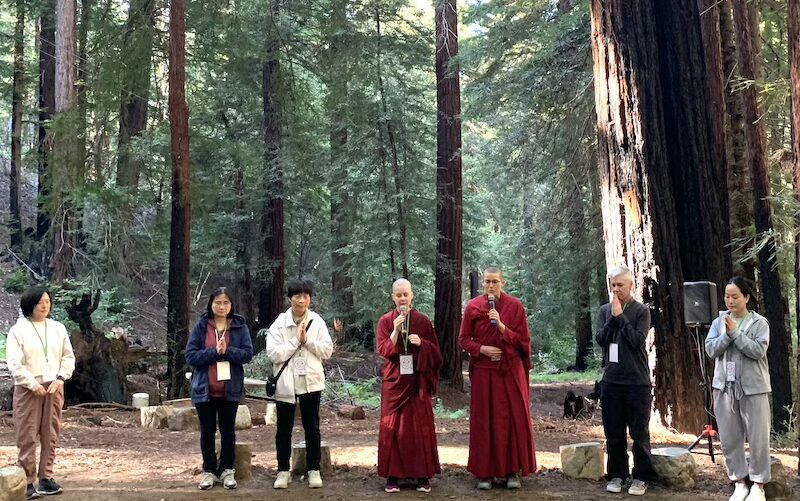
Retreat participants gather at the Stone Circle at Redwood Vihara monastery for an opening ceremony. Photos by Sandy Chiang.
By David Braughton
In May, nearly eighteen years to the day since Buddhist Global Relief was founded, members of the BGR Board of Directors, staff, and volunteer team joined the newly formed Sangha Council at Redwood Vihara monastery in Boulder Creek, California, for our first in-person retreat. The gathering felt both like a homecoming and a new beginning: a chance to reflect on how far the organization has come and to consider how its Buddhist foundation can continue to guide its future.
As I sat quietly in the Redwood Vihara Buddha Hall on Saturday, waiting for the next session to begin, I overheard a bhikkhuni gently remind a Board member to trust in the power of karma. “If we act with wholesome intention,” she said, “wholesome results will follow.” Her words carried me back in time to a small gathering led by Ven. Bhikkhu Bodhi that marked the beginning of BGR. The lay persons in attendance had been moved by Bhante’s 2007 reflection on engaged Buddhism, “A Challenge to Buddhists,” and were united by a shared conviction that compassion must be more than a feeling. True compassion compels action, in all circumstances, and even more so in response to preventable suffering like that of hunger and acute malnutrition.
At the time, what we could offer seemed insignificant, like the light from a single candle illuminating a vast darkness. Yet we knew we had to do what we could. None of us imagined that BGR would grow into the leading hunger-relief organization in Western Buddhism, raising and distributing nearly $2 million each year across about 60 projects worldwide. Nor could we have foreseen the creation of a Sangha Council, designed to safeguard the sacred roots of BGR—a vehicle for carrying BGR’s Buddhist identity forward beyond its founder and beyond any single individual. Sitting in the Redwood Vihara hall almost two decades later, humility and gratitude overwhelmed me as I knew that this gathering was also the fruit of wholesome intentions planted long ago.
Participants came to the retreat from across the United States. Although many had met before online, this was the first time they had gathered in person. The group included BGR Board members, staff members and volunteers, and monastics—both men and women—from Theravada, Tibetan, and Chinese and Japanese Mahayana traditions. Over two and a half days, attendees learned about one another, discussed the history, finances, and daily work of BGR, and reflected on how the path toward liberation can be joined with conscientious compassion. They also considered the role of the Sangha Council in relation to the Board and staff and the Council’s responsibility to help preserve BGR’s distinctive grounding in the Dharma and Buddhist ethics.

Each day began and ended with meditation and chanting led by Sangha Council representatives from the different traditions. These shared practices gave the retreat a steady spiritual rhythm and reminded everyone that BGR’s work is rooted not only in organizational structure, but in lived practice. Throughout the weekend, Bhante, BGR staff, and the monastics challenged participants to think more deeply about the causes of hunger and malnutrition and about the systems that allow such suffering to continue. The discussions made clear that the organization’s mission is not only to respond to immediate need, but also to reflect carefully on how compassionate action and advocacy can address suffering at its roots.
What many participants spoke of most was the quality of the time together. The retreat was described not simply as provocative and productive, but as joyous and deeply nourishing: a blessing, and an expression of spiritual friendship manifested in real time. What emerged was more than conversation. It was an embodied experience of sangha, in which the work of alleviating suffering cannot be separated from the relationships that sustain it. Gratitude ran quietly through the entire retreat: gratitude for the Dharma, for Bhante and his vision that has guided and shaped BGR, for the care of the hosts, and for the many hands and hearts that have fashioned the organization over the years.
That gratitude was not only retrospective. Again and again, it turned toward the future—toward what might grow from the conditions created during these few days together. One reflection captured this beautifully: “We plant the seeds today for the oak tree of tomorrow.” The image lingered because it spoke to something essential about BGR’s work: This is not hurried or transactional service. It is a long unfolding, shaped by intention, care, and interdependence. The retreat itself became a space where insight and action, contemplation and organization, vision and implementation were held together in one shared field of inquiry.
Leadership also emerged as a central theme—not leadership as authority, but leadership as service. Participants expressed appreciation for the vision that has shaped the organization, for the stewards who have carried its work forward, and for the hosts who created a welcoming environment. What stood out was not hierarchy, but shared responsibility and noble friendship. Wisdom, generosity, and accountability were understood as qualities circulating among many people rather than resting with only a few. In that sense, the retreat mirrored the values it sought to embody, showing that how the work is done is inseparable from what the work hopes to accomplish.

The gathering also produced tangible resources that will continue to support the community, including a shared repository for presentations, discussion notes, recordings, and reflections. Yet perhaps its most enduring outcome was less concrete: a renewed trust in the process of unfolding. Seeds were planted through conversation, listening, and the simple act of being together with care and intention. What will grow from those seeds is not yet fully known. But the retreat at Redwood Vihara offered a living example of a deeply Buddhist truth—that transformation arises not through force, but through intentionally cultivating the causes and conditions that allow something meaningful to take root. In coming together as Board, staff, and Sangha, as practitioners and organizers, participants did more than plan for the future. They embodied the principles that will shape it.
David Braughton is the vice-chair of the Board of Buddhist Global Relief.