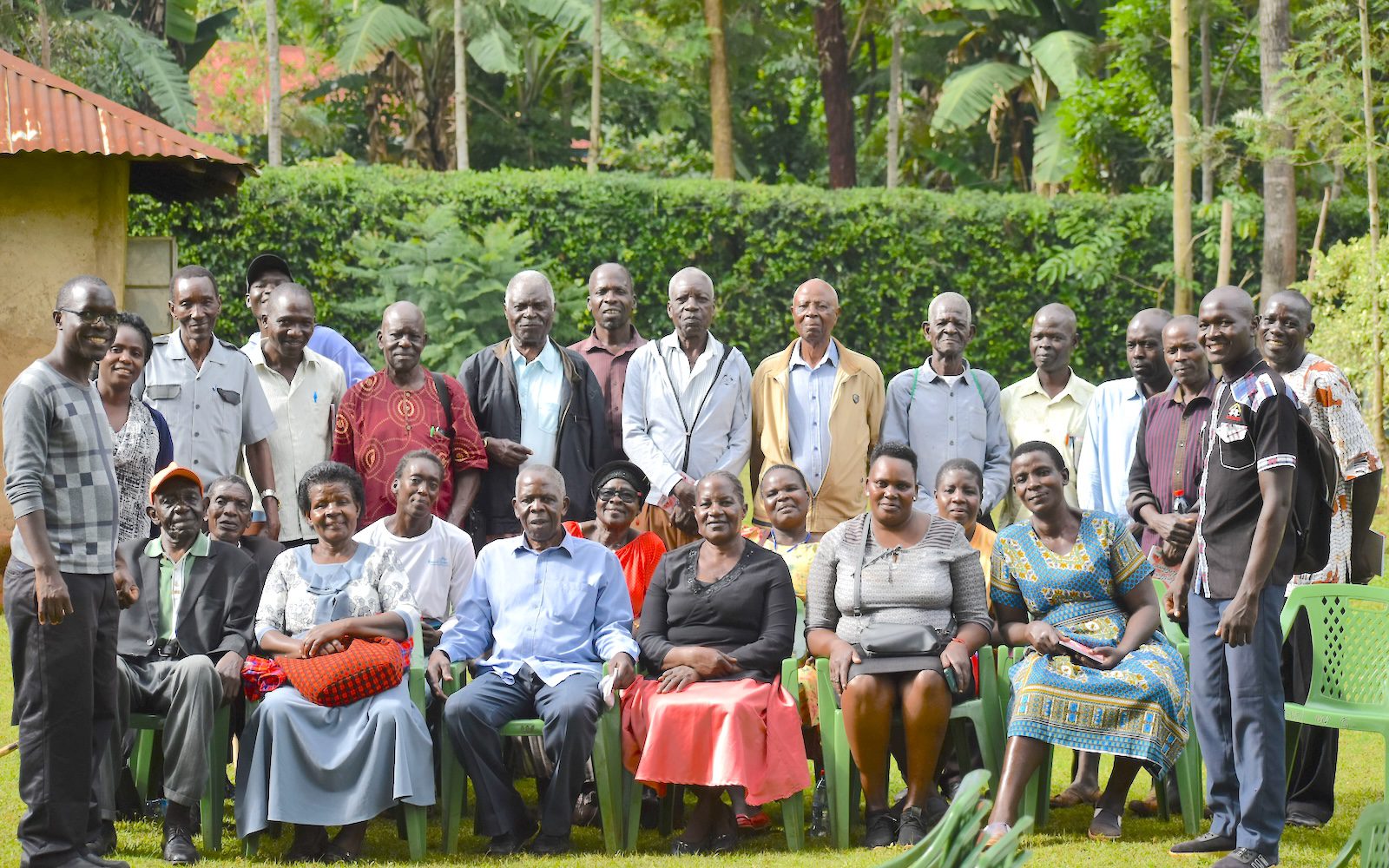
A cohort of lead farmers participating in Farmers Alliance for Restoration—East Africa’s permaculture-inspired sustainable agriculture training. Photo courtesy of FAR–EA.
By BGR Staff
In Kenya’s Siaya County, low-yield agricultural practices and vulnerability to drought and other climate shocks has resulted in high levels of food insecurity and a poverty rate of nearly 50 percent of the population. Poor soils that have been degraded by erosion and the use of synthetic pesticides exacerbate these problems.
A project led by BGR partner Farmers Alliance for Restoration–East Africa (FAR–EA) is providing local smallholder farmers with knowledge and tools to improve their food security and income through a training program based on the holistic agricultural methodology known as permaculture, which emphasizes the use of renewable natural resources and the enrichment of local ecosystems.
FAR–EA trains 30 beneficiaries as lead farmers by equipping them with knowledge through workshops on permaculture skills and techniques. These lead farmers in turn train 19 farmers each through peer-to-peer extension, allowing the project to reach 300 farm families per year. The curriculum includes training in agroecological farming techniques, farmer-to-farmer extension, record-keeping, collaborative citizen science, nutrition, and community-building.
“A key element in the design of these projects is to ensure total ownership of the project is held by the lead farmers, and ultimately the whole community. This is essential to ensure that they continue to work together and continue to benefit from everything they have learned after the two-year project is completed. As FAR–EA develops its work, it will build a wider community to stimulate interactions between the farming communities which have participated in the program, and to develop further services to support them, including better access to markets for their produce.”
—Farmers Alliance for Restoration—East Africa
At a cost of about $65 per farming family, the project is improving nutrition and dietary diversity for local families by increasing yield and diversifying production; strengthening community resilience to climate change and environmental crises; and increasing household incomes through marketing training.
In addition to the single-year permaculture design training for smallholder farmers, the project provides participants and other farmers in the community with continuing support in areas like field implementation, data collection, and improving production for households and markets. The organization therefore seeks to support the farmers in forming community-based organizations and/or farmer cooperatives for their sustainability.

Jacob Ochieng with one of his conical gardens. Photo courtesy of FAR–EA.
Jacob Ochieng is a young man who completed his college education two years ago. He was recruited by FAR–EA lead farmer Alfred Odhiambo to participate in a permaculture training program, during which he became interested in the water-conserving agricultural technique known as conical gardening. Jacob now offers training sessions on his own farm, and he has grown passionate about practicing and teaching what he has learned. “I inspire many young people around here with what I do,” Jacob said.
Francis Ocholla joined one of FAR–EA’s training courses seeking to improve his crop productivity. As a result of his new knowledge and skills in the production of vegetables through permaculture, he now not only grows sufficient vegetables to feed his family but also sells surplus seedlings to other farms as a source of livelihood.
“Many farmers come to me especially during the onset of rains,” Francis said. “During these two months, I sell about 1,500 seedlings a week, which translates to Kes. 60,000 (U.S. $464) per month.” Francis produces seedlings for spinach, kale, and the nutritious leafy green known as African nightshade. He has since become a lead farmer for the program, training others in FAR–EA’s methods of sustainable agriculture.
This article is based on project reporting provided by FAR–EA.