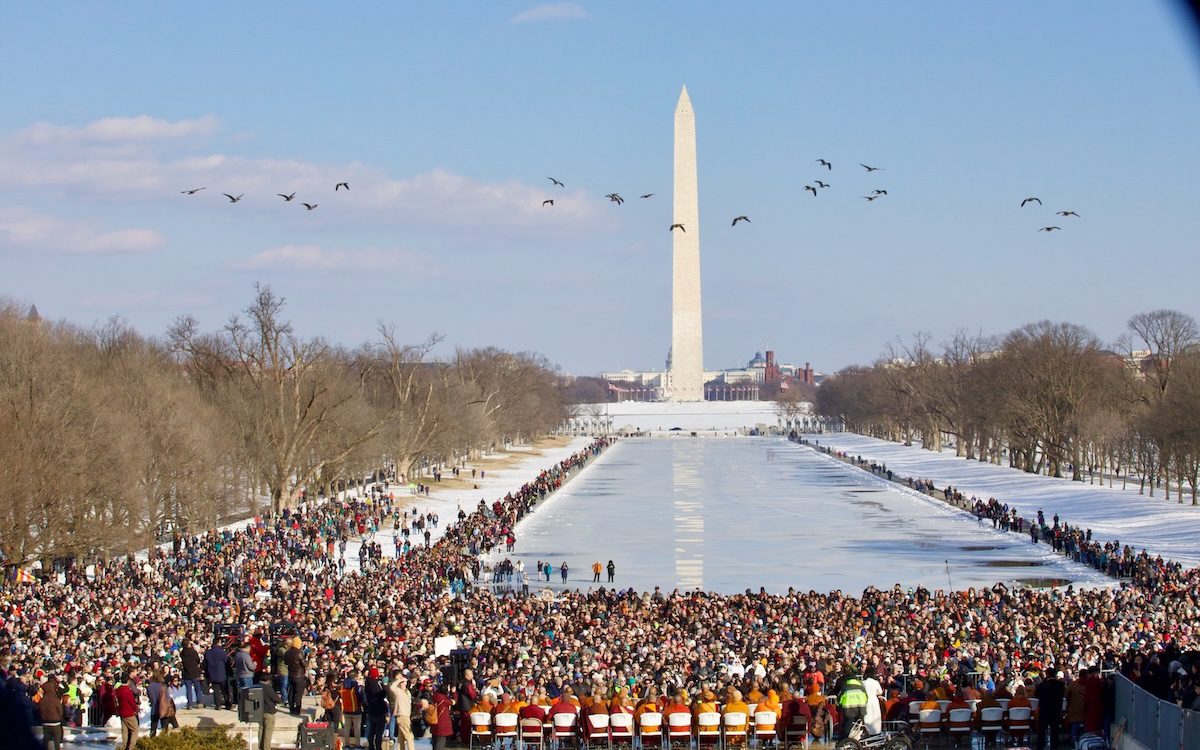
The Walk for Peace gathering at the Lincoln Memorial in Washington, D.C., on February 11, 2026. Photograph by Felixmasi Photography.
By Ven. Bhikkhu Bodhi
Sometimes an event that begins in an inconspicuous way suddenly gains momentum and delivers a colossal impact no one could have foreseen. A random spark spreads through dry brush and sets off a forest fire. A gust of wind on a mountaintop starts an avalanche. Overnight, a streetside folk singer becomes an international sensation. Something similar happened in late 2025, when twenty Theravadan Buddhist monks of diverse ethnicities embarked on a long Walk for Peace. Starting in obscurity, by the time they finished they would be known all around the world.
The monks set out on October 26 from the Huong Dao Vipassana Meditation Center in Fort Worth, Texas, accompanied by their faithful rescue dog Aloka, a Pali word meaning “Light.” Their walk of 110 days would cover 2,300 miles and take them through eight southern states. Their destination was Washington D.C., which they aimed to reach by February 10. Initially, the Walk drew little attention apart from the folks they passed along their route. However, as word of the Walk spread via social media, the numbers of people coming to see them both in person and online rose exponentially.
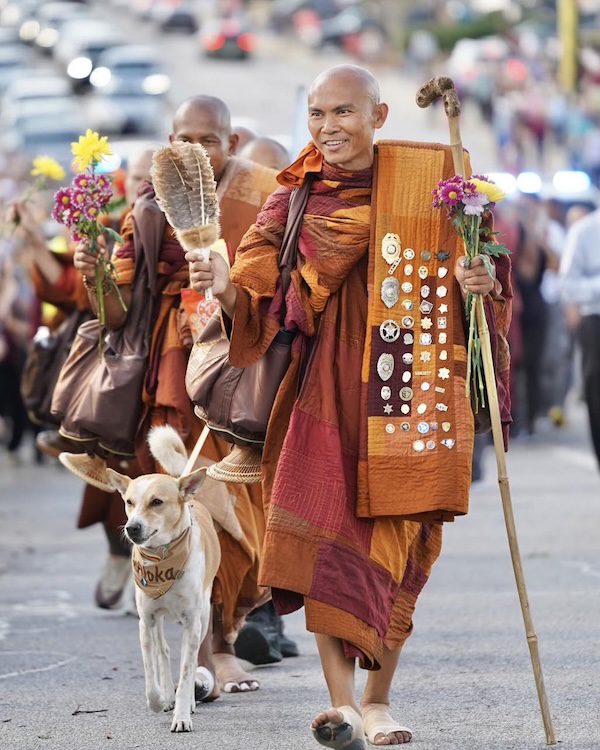
I began following their journey on Facebook and YouTube around the time they entered Alabama. What I witnessed amazed me. I saw people from all walks of life come out to greet the monks, bow to them, and ask for their blessings. Most attendees knew little about Buddhism but were captivated by the idea of twenty Asian men, clad in bronze robes, silently crossing the country with calm demeanors and steady determination. At their stops for their midday meal and nightly rest, the Walk leader, Bhikkhu Paññākāra, gave regular Dhamma talks to the multitudes. Each talk conveyed the same consistent message: slow down, be mindful of your feelings and thoughts, treat others with kindness, and start each day with the resolution, “Today is going to be my peaceful day.”
By the time they reached Columbia, South Carolina, their audience had grown to thousands. Their Facebook page eventually gained two million followers, from all over the world, and even Aloka the Peace Dog had his own page with a million followers. In Raleigh, North Carolina, Governor Josh Stein welcomed the monks and proclaimed the day “Walk for Peace Day.” In Richmond, Virginia, Governor Abigail Spamberger issued her first proclamation as governor by naming the day “Walk for Peace Day.”
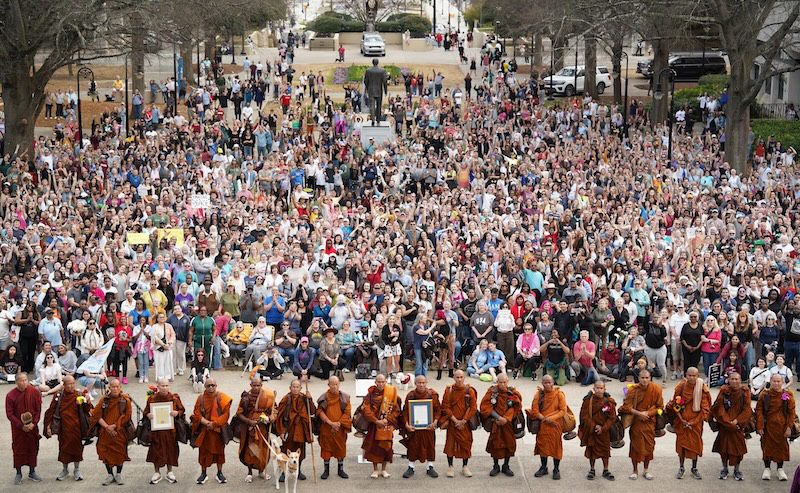
In Columbia, S.C. Photograph courtesy of Walk for Peace Facebook page.
As they neared Washington, the monks called on monastics of all Buddhist traditions to join them for the final events in the nation’s capital. They personally invited me to speak at the concluding ceremony at the Lincoln Memorial, scheduled for February 11. I arrived in Washington on the night of February 9 and the next day attended a public assembly with the monks at American University. By the time I entered the auditorium, more than a hundred monastics and several hundred guests were already present.
When Ven. Paññākāra saw me arrive, he called me to the stage and asked me to speak. I had not prepared any remarks in advance, so when I reached the microphone, I began by reflecting on the reasons the Walk had evoked such a fervent response. I suggested that the Walk resonated so deeply with people in this country because it exposed a sore spot beneath the hard shell of America’s massive wealth and military might: a deep inner poverty, the pangs of loneliness stemming from the divisions that alienated us from each other. The Walk, I said, countered this malady with a reminder of what mattered most: our shared humanity and fundamental unity.
I then added words that would unexpectedly ignite a firestorm. I noted that at the same time the Walk was exalting the ideal of human unity, our country was violating this ideal by defunding the United Nations and dismantling USAID, the U.S. Agency for International Development. These decisions, I said, would have dire consequences, even costing millions of people their lives. I concluded by expressing the hope that the Walk would inspire us to become a more compassionate nation dedicated to promoting peace, unity, and harmony.
Although I had no intention of politicizing the Walk, but merely wished to underscore its ethical implications, some observers gave my talk a reckless political spin. One YouTube news channel even titled its video, “Buddhist Monk Slams Trump Admin in Fiery Speech.” This completely misrepresented my intentions, for I had not mentioned any person or party but spoke only of what “our country” had done. I was heartened, however, by the supportive responses I received from many friends. One came from Roshi Joan Halifax, who told me that I uttered the truth that millions had been witnessing, putting into words what the monks wanted to say but could not openly articulate.
Later that day we walked to the Washington National Cathedral for a public welcoming ceremony and open question-and-answer session. When one member of the audience asked the monks how we can reconcile our quest for inner peace with the pursuit of justice, Ven. Paññākāra invited me to respond. Again, I got myself into “good trouble” (as the late congressman John Lewis put it). I explained that while inner peace is a necessary foundation, we should not rest content with this but use inner peace as a platform for promoting social justice and greater equality. Then, to illustrate the urgency of this task, I spoke about the ICE raids that had traumatized communities across the country, tearing families apart, terrorizing children, and leading to the arrest of thousands of hardworking immigrants.
The next day, after the midday meal, all the assembled monastics—about three hundred at this point—marched through the streets of Washington, heading toward the Lincoln Memorial. The crowds along the route offered flowers, held up signs of welcome, and shouted, “Thank you, thank you so much.” I was especially struck by the many children who lined the streets, brought out by their parents and teachers to witness a sight they would remember all their lives. The warmth of the welcome touched me so deeply that at intervals a lump would form in my throat and tears moisten the corners of my eyes.
On reaching the Lincoln Memorial, the speakers and special guests gathered on the top steps, overlooking the multitude assembled on the National Mall—probably between 8,000 and 10,000 people. About 30,000 watched the program online. We sat on the very spot where, in 1963, Martin Luther King had delivered his famous “I Have a Dream” speech. Our own assembly seemed to be continuing in that spirit, and I could almost hear silent applause from Lincoln and King descending from the heavens.
In my brief speech at the memorial, I praised the Walk as one of the most important, inspiring, and uplifting events of the twenty-first century. I emphasized that the Walk had brought forth the best quality of the American character: the recognition that regardless of our race, faith, or place of origin, we were all essentially equal; that we all shared a yearning for peace, kindness, and compassion; that we all wanted to create a nation built on mutual affirmation and solidarity. Ven. Paññākāra gave the concluding talk in which he highlighted the five guiding values of the Walk: love, kindness, compassion, harmony, and hope.
Over the preceding weeks, as I watched the Walk on YouTube and Facebook, one doubt kept on gnawing at my mind. Was it enough, I wondered, to instruct people merely to make the daily resolve, “Today will be my peaceful day”? While this maxim highlights the need for inner peace, I questioned whether it offered an adequate antidote to the violence and hatred that had become so rampant over the past year, flaring up in the attacks on immigrants, the inflammatory political rhetoric, and the increase in American military actions at various hot spots around the world. The thought kept on troubling me: “Was teaching people how to cultivate inner peace enough to pave the road to global peace? What about Ukraine? What about Gaza? Our threats against Iran? The strikes on boats in the Caribbean? The crackdown on immigrants and trans people? Shouldn’t these be named?”
In the end, while I felt these questions were pertinent, I realized that the monks were right to avoid linking their Walk to any political agenda, however worthy. Through their quiet determination, their unwavering resolve to forge ahead despite all challenges, the monks sent the nation and the world the message they needed to hear. They had caused old walls to crack and tumble, teaching a powerful lesson of peace, compassion, and human unity that had moved the hearts of millions. Their silence on issues of public concern was, I believe, not an evasion of social responsibility but a way of awakening in us a unitary consciousness that binds us together in a shared recognition of our essential oneness.
Two days later, another opportunity opened up for me to turn my ethical convictions into action. Back in January I had received an email announcing a Moral March in North Carolina from February 11 to 13, culminating in a Mass People’s Assembly in Raleigh on Valentine’s Day, February 14. The program was organized by Repairers of the Breach, a social justice movement led by Bishop William Barber II, a pastor, preacher, and co-founder of the Poor People’s Campaign. Since I was already in Washington in February, I decided to travel further south after the Walk and join the march and assembly. This would also give me the chance to visit my niece, a professor of sociology at North Carolina State University in Raleigh.
When I contacted the Repairers of the Breach, they warmly welcomed me and offered me a speaking spot at the assembly. They were delighted to have a Buddhist monk on board, probably for the very first time. After reaching Raleigh on February 12, the next day I joined the final leg of the march—a five-mile trek from Knightsdale to Raleigh. Unlike the silent Walk for Peace, this march featured chants, songs, and placards about the issues that weighed most heavily on people’s hearts. When we reached Raleigh, Bishop Barber had me conduct a short loving-kindness meditation for the marchers.
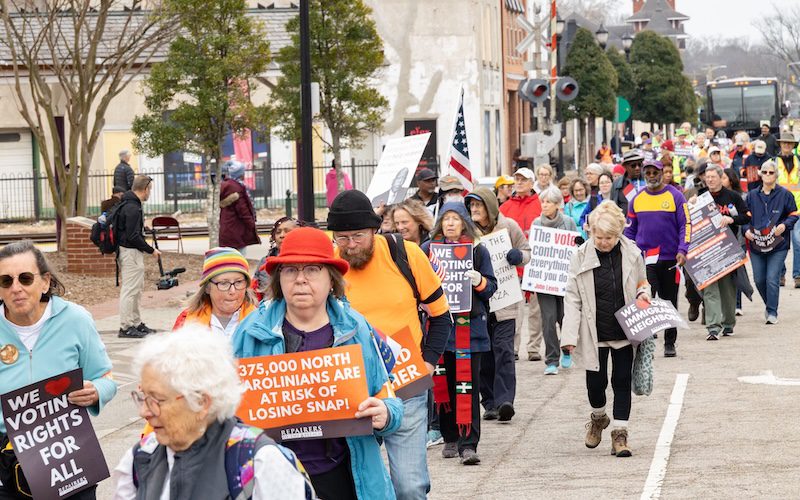
Repairers of the Breach march on February 12. Photo courtesy of Repairers of the Break Facebook page.
The theme of the march and assembly was “Love Forward Together.” The word “love” conveyed the spirit of the gathering; “forward” emphasized the progressive agenda for democracy and justice; and “together” highlighted the importance of collective action. The program culminated on February 14 in the two-hour Mass People’s Assembly. Here, the speakers did not shy away from issues of public concern but boldly proclaimed their convictions. Since it was Valentine’s Day, Bishop Barber asked us to state clearly what we love. We said we loved lifting people out of poverty; we loved voting rights for all; we loved paying workers a living wage; we loved universal health insurance and public education; we loved renewable energy; we welcomed immigrants; we loved the religious values of mercy, grace, and empathy.
My short talk came near the end of the day’s program. The director, Dr. Hanna Broome, initially allotted me one minute to speak, but I persuaded her to grant me two minutes, and I managed to pack a lot into that brief time span! I began by quoting Martin Luther King’s famous words: “We are all tied together in a single garment of destiny, caught up in an inescapable network of mutuality.” This, I said, means that we are not isolated individuals locked in our personal identities; rather, our lives are interdependent, interconnected, and mutually penetrative. This interconnectedness, I continued, entails the moral obligation of love, which in practice means we must work together to ensure justice and equality for all, build a sound economy that supports everyone, and make America a nation of boundless generosity and compassion ready to uplift people throughout the world. With these words, I felt that I had knitted the messages of the Walk for Peace and the Moral Assembly into a seamless unity, joining our quest for inner peace to our responsibility for the good of all.
Ven. Bhikkhu Bodhi is Founder and Chair of Buddhist Global Relief.