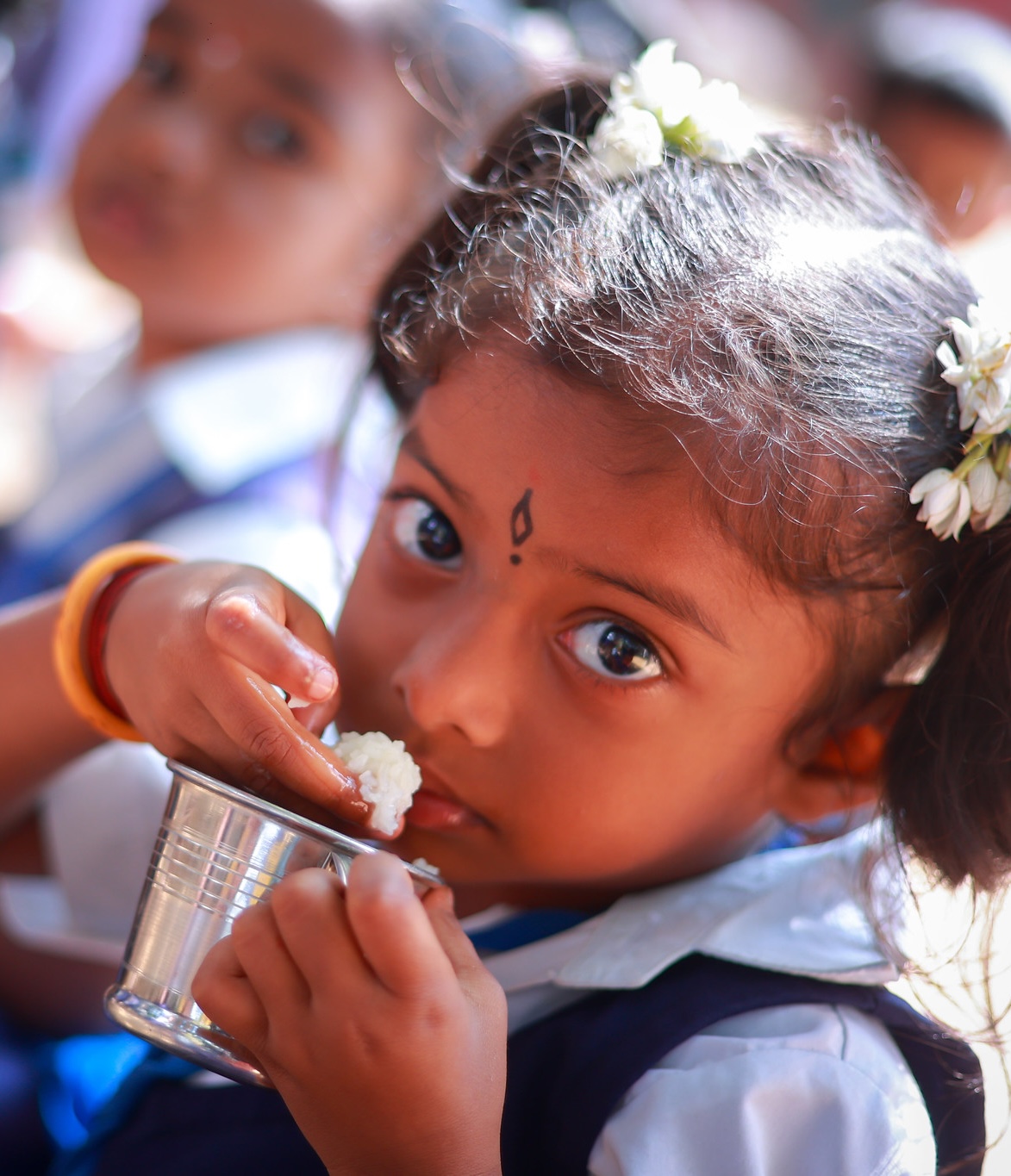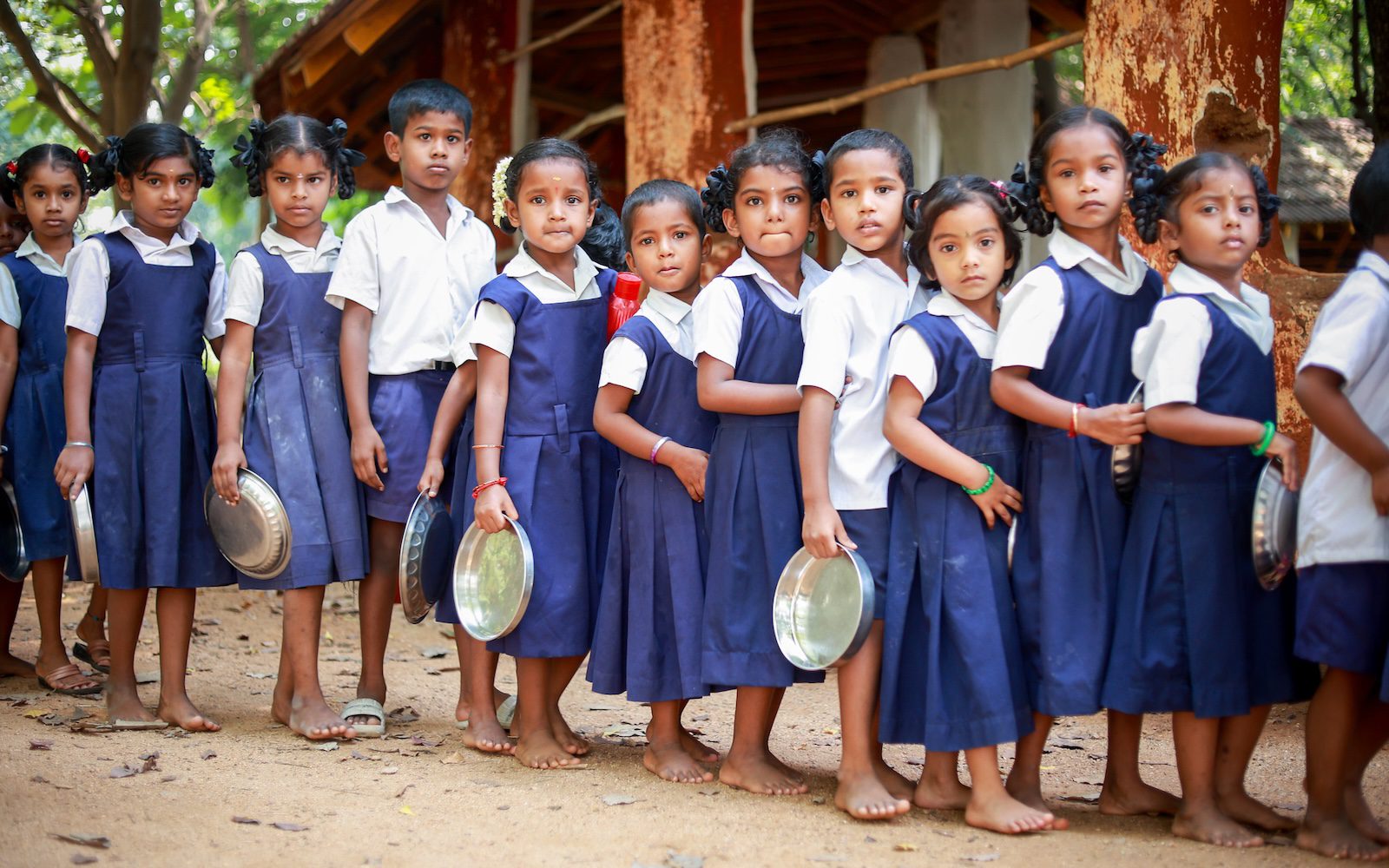
Children at the Garden of Peace School in Tamil Nadu, India, queue up for a daily meal made possible by a BGR-supported school feeding program. Photograph courtesy of Lotus Outreach Australia/White Lotus Charitable Trust.
By David Braughton
At Buddhist Global Relief, we are guided by a simple but demanding conviction: to relieve chronic hunger and malnutrition and to help build a world where those most neglected can rise up, thrive, and realize their fullest potential. Our vision is not abstract charity; it is the categorical insistence that food, health, and dignity are basic supports of a meaningful life. When major humanitarian systems are dismantled and nutrition and maternal–infant supports are sharply reduced, the consequences land—first and foremost—on those already living on the brink.
From this perspective, the elimination of the United States Agency for International Development (USAID) marks the loss of the primary avenue through which the United States has historically implemented large portions of its foreign assistance. USAID’s mission included operating programs central to hunger reduction, agricultural resilience, and maternal–child survival. Both the short- and long-term impacts of closing USAID and ending its essential programs will be devastating.
The policy shift began with an executive order issued by Trump on January 20, 2025, the very first day of his new administration. The order imposed a 90‑day pause on U.S. foreign development assistance while programs were reviewed for alignment and efficiency, with enforcement delegated to the Office of Management and Budget. Subsequent reviews and stop‑work orders disrupted implementation across nearly all USAID programs. By mid‑2025, USAID offices were closed, approximately 83 percent of its programs were terminated, and its remaining functions were transferred to the Department of State.
The moral question raised by this shift is not partisan; it is profoundly human: What are the impacts of the eradication of hunger programming, agricultural development, and maternal–infant health at the precise moment they are needed most? What happens when the government suddenly cuts agriculture programs by roughly 81 percent, reduces maternal and child health programs by approximately 92 percent, and slashes related nutrition and family planning services? What are the consequences when these cuts effectively close down aid programs in regions already facing military and social conflict, displacement, and climate stress, such as Central and East Asia, West Africa, Central Europe, and the Americas?
The consequences include an estimated 8 million to 14 million additional deaths globally by 2030, including more than 4.5 million children under 5—all the result of the executive order and subsequent reductions in funding. Contrast this outcome with the estimated 91 million deaths that were prevented between 2001 and 2021 in low- and middle-income countries thanks to programs supported by USAID at a cost to U.S. taxpayers of about 17 cents a day or about $64 per year.
In Buddhist ethics, such outcomes are not merely morally repugnant; they test our collective commitment to non‑harm and compassion in action. The Buddha taught that when we embrace a morality of non-harm, not only do we abandon the taking of life or intentionally injuring others, but our hearts tremble for the welfare of all living beings.
Structural decisions that predictably increase preventable death from hunger and untreated illness are not compassionate, nor do they exemplify a heart that “trembles for the welfare of all beings.” They represent instead the cruelty and callousness of ego and self-aggrandizement memorialized by the deaths of millions of poor and marginalized people and epitomized in the slogan “America First.”
Some commentators argue that the administration’s America First Global Health Strategy provides a satisfactory replacement framework for U.S. global health engagement. Released in September 2025, the America First strategy is explicitly organized around three pillars—“Safer, Stronger, and More Prosperous”—and emphasizes outbreak surveillance, rapid response, and multi‑year bilateral agreements with co‑investment and performance benchmarks.
From the standpoint of BGR’s mission—food justice and the alleviation of hunger—the America First strategy is no replacement for USAID. It is, rather, an ultimately self-defeating, self-serving justification for the heartless disregard for the welfare of anyone other than one’s own clan or tribe or social class. The root causes of disease, social unrest, dependency, and much of the political strife we see around the world are poverty, hunger, malnutrition, climate change, a lack of resources, and ineffective leadership. By ignoring these, the America First strategy not only will prove ultimately unsuccessful but may well contribute to the outbreak of future pandemics, social conflict, war, mass migrations, and economic collapse.
The Buddha taught that “hunger is the worse form of illness” and that “the gift of food is the gift of life.” He also taught that generosity, morality, and compassion are the starting points of spiritual practice. Policies that abolish food aid and health care for the underprivileged, which give no hope for a better life, such as the America First strategy, stand in stark contrast to these teachings.
For BGR, generosity is not only about the moral cultivation of the giver, but also about supporting systems, such as USAID, that keep people alive, especially at their most vulnerable moments. Similarly, morality is not just a set of rules that individuals must follow; morality must guide the social order in ways that ameliorate collective suffering and help us live in harmony with our planet and one another. This means that we must actively address those causes and conditions of suffering. Instead of putting “America First,” we must put people first.
The same can be said about compassion. For BGR, compassion is not a sentiment; it is a readiness to recognize suffering clearly and to respond through service—with integrity, concrete action, and advocacy. True compassion is guided by insight and wisdom and compels us to wrestle with the hard realities we face. The fact is that no amount of individual largesse or even corporate philanthropy can fill the gap left by the abolition of USAID and its many programs. Sadly, there appears to be little concern on Capitol Hill for resurrecting USAID or at least restoring its lost programs.
That’s why it is left to us as citizens to voice our concerns, to call on our senators and representatives to let them know that a health strategy that protects borders from outbreaks is not the same as a hunger strategy that protects children from wasting, mothers from preventable death, and subsistence-farming families from starvation. We must impress on these leaders, through our emails, letters, phone calls, comments at town hall meetings, and votes, that hunger, agricultural development, and maternal–infant nutrition must be treated as essential rather than optional elements of a truly moral, humane, and robust foreign policy. Finally, we must do what we can to expand philanthropic partnerships, support proven hunger relief and sustainable agriculture initiatives, and advocate for an international food system grounded in social justice and ecological sustainability—aims that BGR explicitly embraces.
At a time when aid narrows and suffering widens, compassion must step in and step up. Compassion asks us to see suffering clearly and compels us to refuse indifference. Generosity requires us to go the extra mile, use all the resources at our disposal, and do what we can to make a change for the better. We must say no to the cynical exceptionalism of “America First,” recognize that our fate is inextricably bound up with all the people living on this planet, and do what we can to create a world where everyone can thrive.
David Braughton is the Vice-Chair of Buddhist Global Relief and Chair of BGR’s Projects Committee.